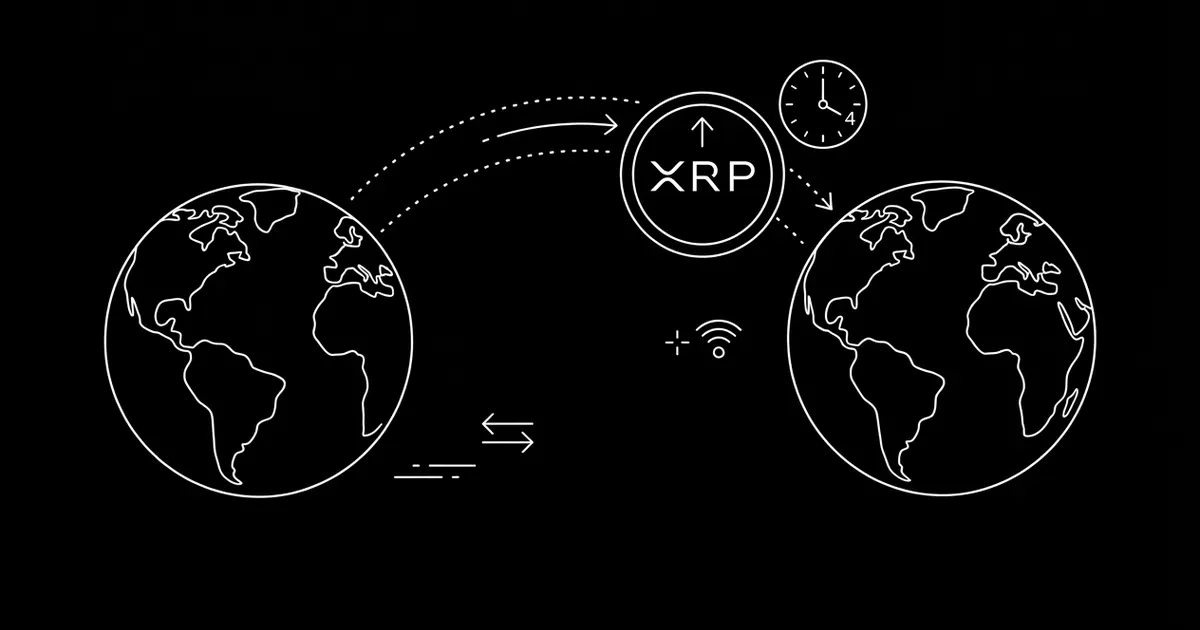
The XRP Ledger was built for payments before 'crypto payments' was a category: transactions reach deterministic finality in about four seconds and cost fractions of a cent, with no mining and no fee auctions. For a merchant, that means the money either arrived, finally, or it didn't — there is no probabilistic waiting game.
This guide covers what deterministic finality actually buys you, the one XRP-specific concept every merchant must understand (destination tags), a worked cross-border example, and a non-custodial setup where every payment lands in a wallet only you control.
why XRP for payments
Most chains give you probabilistic finality — a payment becomes less reversible with each block, and you choose how long to wait. The XRP Ledger closes a ledger every few seconds by validator consensus, and once a transaction is in a validated ledger, it is final. Full stop. For merchant operations this is delightfully boring: no confirmation policy debates, no 'wait longer for larger amounts' tables.
Add fees of fractions of a cent and you get a rail that suits invoices of any size — the network cost is identical whether the payment is $5 or $50,000.
finality compared
What 'the money is yours now' looks like across rails:
| rail | final in | how finality works | network fee |
|---|---|---|---|
| XRP Ledger | ~4 seconds | deterministic — validated ledger is final | fractions of a cent |
| Solana | ~1–2 seconds | fast probabilistic, quickly rooted | fractions of a cent |
| Bitcoin | ~10 min – 1 hour | probabilistic, deepens per block | often under $1 |
| card payment | months | auth is instant, chargebacks reverse it later | 1.5–3.5% to the merchant |
a worked example: the exporter
An exporter invoices an overseas buyer $12,000. By SWIFT wire: $30–60 in bank charges, a 1–3% FX spread hidden in the rate, and 2–5 business days — during which the goods wait and the deal can wobble. Intermediary banks sometimes take their own cut en route.
The same invoice in XRP: the buyer pays from their wallet, the network fee is a fraction of a cent, and the funds are final in the exporter's own wallet about four seconds later — with an on-chain receipt both sides can verify. On a non-custodial page the platform fee is 0%; the exporter converts to stablecoins or fiat on their own schedule, not a processor's.
pricing and volatility
XRP is a volatile asset, so price the sale in your currency and let the payment page convert at payment time with a short locked quote — the customer pays an exact XRP amount and drift never becomes a dispute. What you do after settlement (hold, convert a portion, sweep to cold storage) stays your decision on a non-custodial rail.
confirmation policy
This is the easiest section of any coin guide: there is nothing to configure. A validated XRPL transaction is final, so a good gateway marks the order paid the moment the ledger containing it validates — about four seconds after the customer hits send. crypt.pe watches the ledger and matches the exact amount to the invoice automatically.
mistakes to avoid
- Receiving into an exchange address. You'd inherit the destination-tag problem for every single customer payment — receive into your own wallet and tags become irrelevant.
- Confusing XRP with wrapped or exchange-listed lookalikes on other chains. Real XRP settles on the XRP Ledger; your payment page should be watching the XRPL, nothing else.
- Forgetting the base reserve. A brand-new wallet needs its small activation balance (currently 1 XRP) before it can receive.
- Quoting XRP amounts by hand. Always quote fiat and let the page lock the conversion at payment time.
- Skipping the test payment. One small test validates address, ledger detection and the receipt in four seconds flat.
go-live checklist
- 1. Create a self-custody XRPL wallet (Xaman or hardware); back up the seed on paper.
- 2. Fund it with the small base reserve so the account is active.
- 3. Paste the public r… address into your payment page and enable XRP.
- 4. Send yourself a small test payment and check the receipt.
- 5. Put the link on invoices, your site and the printable QR standee.
references
- [1]XRP Ledger docs — payments & destination tags
- [2]XRP Ledger docs — transaction cost
- [3]XRPL explorer — livenet.xrpl.org
primary sources last verified — details may change; confirm on the source pages.
frequently asked
How do I accept XRP payments as a business?
Add your public XRPL wallet address to a non-custodial payment page, share the link or QR, and payments settle directly to your wallet with ~4-second finality. With crypt.pe there's no identity check required to start and 0% platform fees.
What is a destination tag and do I need one?
Destination tags are numeric routing codes exchanges use because all their customers share one deposit address. Receiving into your own self-custody wallet, you don't need one — your address is exclusively yours. Only worry about tags when sending to an exchange.
How fast do XRP payments confirm?
About four seconds to deterministic finality — once the ledger containing the transaction validates, the payment is final, whatever the amount. Network fees are fractions of a cent.
Is accepting XRP safe for merchants?
Validated XRPL transactions are final — no card-network chargebacks. Keep it non-custodial (funds go straight to your own wallet), protect your seed phrase, and enable 2FA on your account.