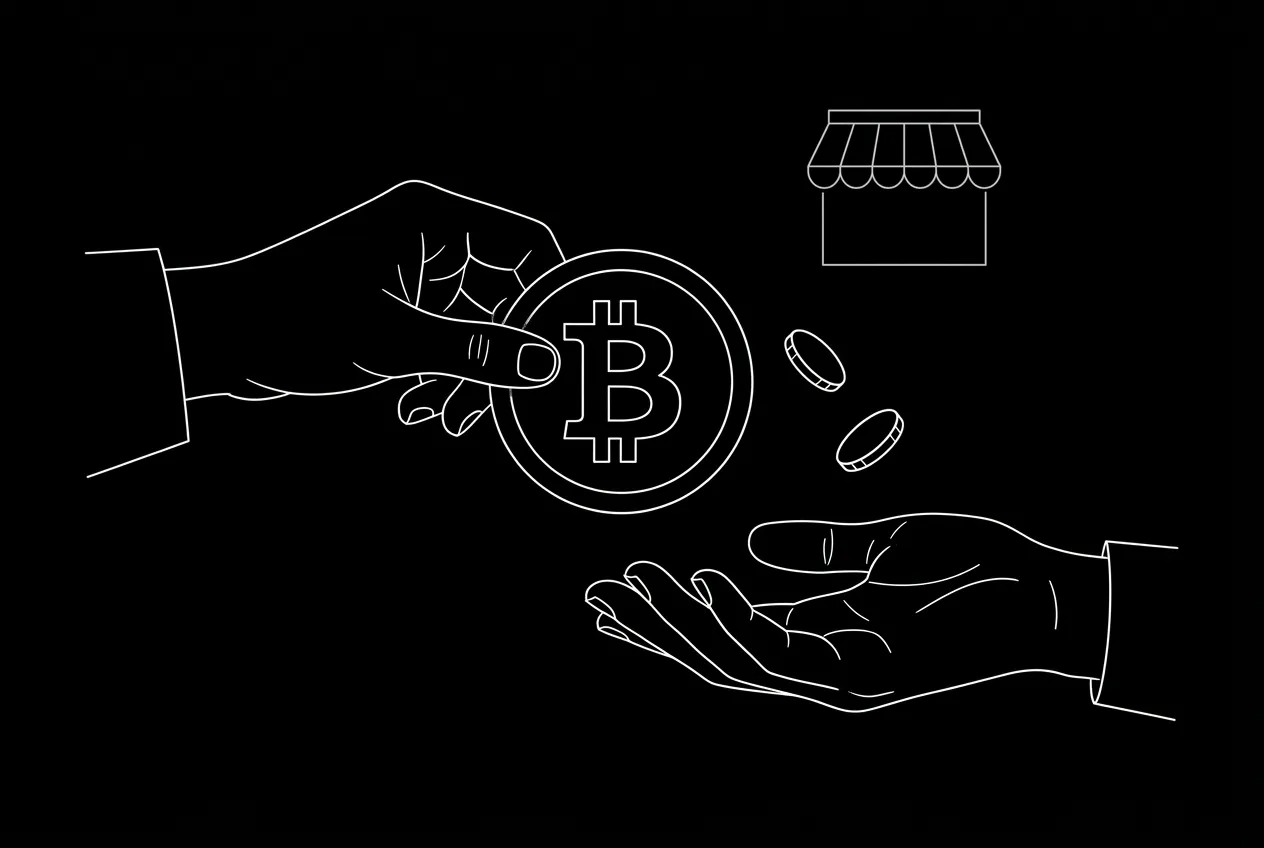
Bitcoin is still the asset customers are most likely to actually hold, and for a merchant it settles with no card-network chargebacks and no card network in the middle. What stops most businesses isn't demand — it's uncertainty about wallets, confirmation times and price swings. This guide answers those three questions with the specifics.
Everything here assumes a non-custodial setup: payments land in a wallet you control, not in a processor's account you withdraw from.
why accept bitcoin specifically
Stablecoins win on convenience, but Bitcoin wins on reach. It's the most recognised crypto asset on earth, the one long-term holders are most willing to spend on things they care about, and the one your customers are most likely to already own. For high-ticket sales — consulting, hardware, services — BTC requests convert surprisingly well because the buyer doesn't need to acquire anything first.
It's also the simplest chain story you'll ever tell a customer: one network, one asset, no 'which chain did you send on?' conversation. A Bitcoin address only ever receives Bitcoin.
the wallet decision
You need a self-custody Bitcoin wallet that gives you the public receiving side without ever exposing your keys to a website:
- software wallets (Blockstream Green, BlueWallet, Sparrow) — free, fine for everyday volume
- hardware wallets (Jade, Ledger, Trezor) — keys never touch an internet-connected device; right choice once balances get serious
- what you share with a payment tool: a receiving address, or better an xpub/zpub so every sale gets a fresh address — never the seed phrase
The fresh-address point matters more on Bitcoin than anywhere else: BTC's ledger is fully public, so reusing one address publishes your entire revenue history to anyone with a customer receipt. An xpub-based page (crypt.pe supports this) rotates addresses automatically while everything still lands in the same wallet.
confirmations: how long is 'paid'?
A Bitcoin block arrives roughly every 10 minutes, and how many you wait for should scale with the amount:
| order size | sensible policy | typical wait |
|---|---|---|
| coffee-sized | seen in mempool / 0-conf | seconds |
| up to a few hundred $ | 1 confirmation | ~10 min |
| four figures | 2-3 confirmations | 20-30 min |
| five figures+ | 6 confirmations | ~1 hour |
Don't hand-verify any of this. A proper payment page watches the address, shows the customer a live status, and marks the order paid at the confirmation depth the amount deserves — crypt.pe applies amount-based confirmation gates automatically.
handling the volatility question
BTC's price moves, and your invoice shouldn't. The standard pattern is a time-locked quote: price the sale in your currency, convert to BTC at payment time, and lock that amount for a short window (crypt.pe locks quotes and matches the exact satoshi amount to the invoice). The customer pays a fixed number; you never argue about rate drift.
What you do after settlement is a business decision: hold the BTC, swap some to stablecoins on an exchange you trust, or sweep to cold storage on a schedule. The tooling should not make that decision for you — that's precisely the freedom custodial processors take away with forced auto-conversion.
fees, honestly
- network fee — paid by the customer, congestion-dependent: often under $1, occasionally a few dollars during fee spikes
- processor fee — 0% on a non-custodial page; custodial BTC processors typically take 0.5-1% plus payout fees
- no card-network chargebacks, no reserves, no rolling holds — a confirmed Bitcoin payment is final
step-by-step BTC setup
- 1. Create or reuse a Bitcoin wallet; write the seed on paper.
- 2. Export the account zpub (watch-only) — in Blockstream Green it's under account settings.
- 3. Add it to your payment page so each sale gets a fresh bc1q… address.
- 4. Send yourself a $2 test payment and watch it confirm on the receipt.
- 5. Put the page link on invoices and print the QR standee for your counter.
- 6. Set a sweep habit: move accumulated funds to cold storage monthly.
references
- [1]Bitcoin developer guide — payment processing
- [2]BIP-21 payment URI scheme
- [3]mempool.space — live Bitcoin fee estimates
primary sources last verified — details may change; confirm on the source pages.
frequently asked
How long does a Bitcoin payment take to confirm?
Payments appear in seconds and confirm roughly every 10 minutes per block. Small sales are safe at 0-1 confirmations; reserve the full hour (6 confirmations) for genuinely large amounts.
What happens if the Bitcoin price changes while a customer pays?
Use time-locked quotes: the invoice converts your fiat price to BTC at payment time and locks the exact amount for a short window, so the customer pays a fixed number regardless of drift.
Do I need a new Bitcoin address for every payment?
Strongly recommended. Address reuse publishes your revenue history on the public ledger. Share an xpub/zpub with your payment tool and every sale gets a fresh address that still lands in your wallet.
Can a Bitcoin payment be reversed or charged back?
No. Once confirmed, a Bitcoin transaction is final. That removes chargeback fraud entirely — and also means refunds are a deliberate action you take, not something imposed on you.