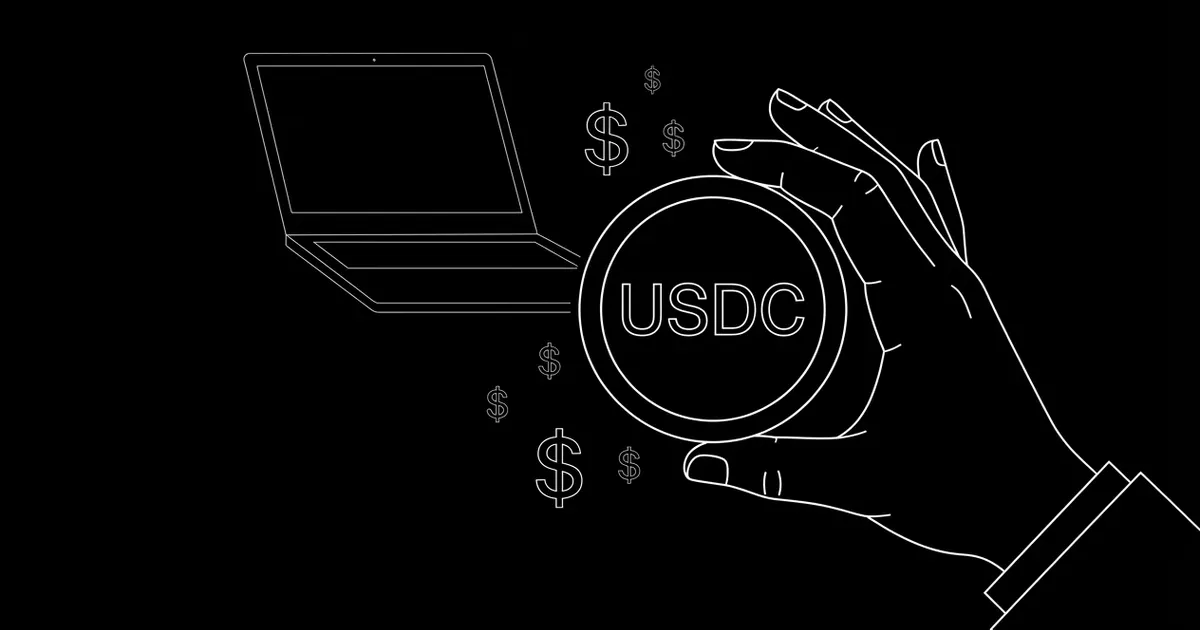
USDC is the regulated, fully-reserved dollar stablecoin issued by Circle — the one businesses and US/EU clients trust most. Monthly third-party attestations back every token 1:1 with cash and short-term treasuries, which makes it the easiest crypto asset to explain to an accountant.
This guide covers the practical setup: which network to pick (it matters more than most merchants realise), what it actually costs next to cards, the mistakes that trip up first-time USDC merchants, and how to go live in about a minute — non-custodial, so every payment lands in a wallet only you control.
why USDC specifically
Stablecoins remove the one objection every merchant has about crypto — volatility — and USDC is the stablecoin built for businesses that care about optics. Circle is a regulated US issuer, reserves are attested monthly by a Big Four accounting firm, and the reserve composition (cash and short-dated US treasuries) is published. When a client's finance team asks 'what exactly are we paying you in?', USDC is the answer that ends the conversation.
USDT still dominates raw volume, especially in emerging markets — but USDC wins with startups, SaaS vendors, agencies and anyone invoicing US or EU companies. Many merchants simply enable both and let the payer choose.
pick your network — the decision that sets your costs
USDC is the same dollar on every chain it runs on; what changes is the network fee your customer pays and how fast the payment is spendable. On crypt.pe, USDC settles on Ethereum, Base, Polygon, BSC and Solana:
| network | typical network fee | spendable in | best for |
|---|---|---|---|
| Ethereum mainnet | roughly $1–5, congestion-dependent | ~15 sec – 2 min | corporate payers, large invoices |
| Base | around a cent | seconds | default choice for most merchants |
| Polygon | around a cent | seconds | high-frequency, small payments |
| BSC | a few cents | seconds | customers on Binance-ecosystem wallets |
| Solana | fractions of a cent | ~1–2 seconds | point-of-sale speed |
A sensible default: offer Base or Polygon first — same dollar, cents in fees — and keep Ethereum mainnet enabled for corporate payers whose treasury policy only allows mainnet.
wallet setup
You need a self-custody wallet that supports the networks you enable — Trust Wallet, SafePal, MetaMask and the major hardware wallets all do. Two practical notes: your Ethereum, Base, Polygon and BSC address is the same 0x… address (one backup covers all four), while Solana uses a separate address format, so you'll add that one separately.
Share only public receiving addresses with your payment tool — never a seed phrase. On crypt.pe, paste an address once and USDC appears on your payment page with a QR, live network selection and pricing in your display currency.
a worked example: the $6,000/month studio
A design studio invoices $6,000/month to overseas clients. On cards it pays roughly 2.9% + $0.30 per transaction plus a cross-border surcharge — call it $190–220/month, $2,300–2,600/year, before chargebacks and rolling reserves. On PayPal, cross-border fees plus currency conversion typically land between 4–6%.
The same $6,000 in USDC on Base: the client pays around a cent in network fees, funds are spendable in seconds, the platform fee on a non-custodial page is 0%, and there is no card-network chargeback window hanging over the revenue. The studio's only recurring cost is a flat subscription for invoice tracking — not a percentage of income.
pricing: the stability advantage
USDC is the stability play: $100 invoiced is $100 received. There's no locked-quote anxiety, no conversion pressure and no 'the price moved while they paid' conversation. Your payment page still shows the local-currency equivalent so customers outside the US always understand the number they're paying.
confirmation policy
A good gateway watches the chain and marks the order paid automatically. On crypt.pe, detection is automatic and confirmation depth scales with amount — small sales feel instant, large ones wait a few extra blocks for appropriate finality. On Base, Polygon and Solana that's still seconds; on Ethereum mainnet, seconds to a couple of minutes.
mistakes to avoid
- Letting customers guess the network. USDC on Ethereum and USDC on Base are the same asset on different rails — a good payment page makes the customer pick from a list so funds always arrive where you're watching.
- Treating USDC and USDT as interchangeable in your books. Same dollar peg, different issuers and different risk profiles — record which one you actually received.
- Enabling only Ethereum mainnet. A $30 payment with a $3 gas fee is a 10% surcharge your customer feels; enable a cheap network as the default.
- Receiving into an exchange deposit address. Exchanges can change or retire deposit addresses; always receive into a wallet where you hold the keys.
- Skipping the test payment. Send yourself $2 before the first client does — it validates the address, the network and the receipt in one step.
go-live checklist
- 1. Create or reuse a self-custody wallet; back up the seed on paper.
- 2. Paste your 0x address (and Solana address if you want that rail) into your payment page and enable USDC.
- 3. Send yourself a small test payment on your default network and check the receipt.
- 4. Put the link on invoices, your site and the printable QR standee.
- 5. Decide a sweep habit: leave working balance hot, move the rest to a hardware wallet monthly.
references
- [1]Circle — USDC official
- [2]Circle — monthly USDC reserve attestations
- [3]ERC-20 token standard — ethereum.org
primary sources last verified — details may change; confirm on the source pages.
frequently asked
How do I accept USDC payments as a business?
Add your public wallet address to a non-custodial payment page, share the link or QR, and payments settle directly to your wallet on Ethereum, Base, Polygon, BSC and Solana. With crypt.pe there's no identity check required to start and 0% platform fees.
Which network should I use for USDC payments?
Base or Polygon are the practical defaults — the same dollar with network fees around a cent and settlement in seconds. Keep Ethereum mainnet enabled for corporate payers whose policy requires it, and Solana if you want point-of-sale speed.
What's the difference between USDC and USDT for merchants?
Both track the dollar 1:1. USDC is issued by Circle, a regulated US company, with monthly attested reserves — the easier asset to explain to accountants and US/EU clients. USDT has the larger global volume, especially in emerging markets. Many merchants enable both.
Is accepting USDC safe for merchants?
Confirmed on-chain payments are final — no card-network chargebacks. Keep it non-custodial (funds go straight to your own wallet), protect your seed phrase, and enable 2FA on your account.