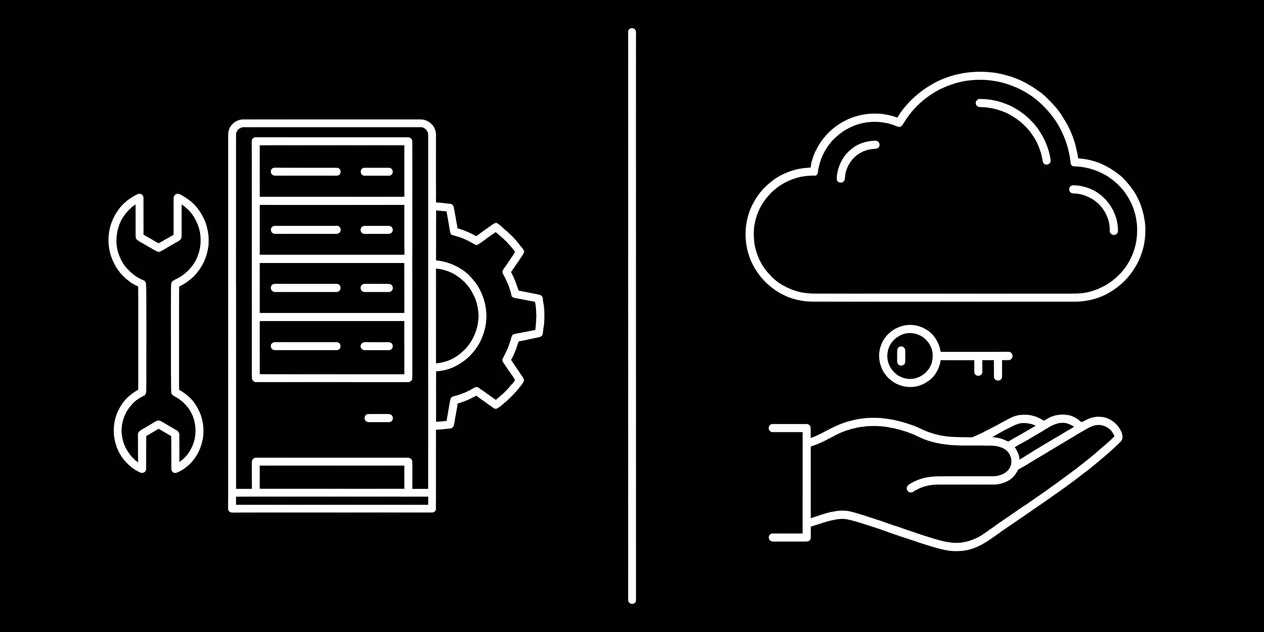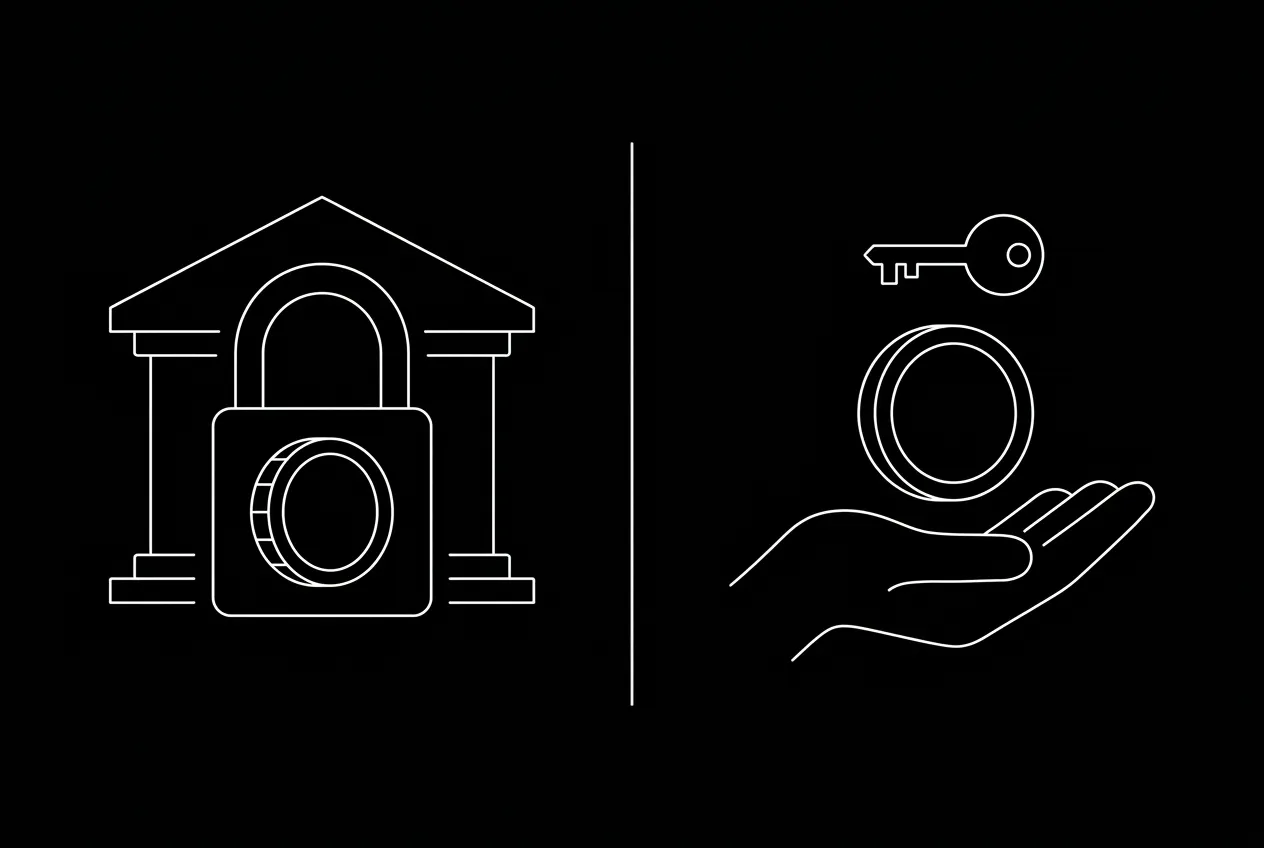
Every crypto payment product on the market sits in one of two camps, and the difference is not a feature — it's who holds your money. Custodial processors receive customer payments into their own wallets, then credit your balance for later withdrawal. Non-custodial tools route payments directly from the customer's wallet to yours and never touch the funds.
This guide lays out what each model actually means for a business: control, risk, fees, compliance and the failure modes of both.
the two architectures in one minute
| custodial (BitPay, Coinbase Commerce*, NOWPayments) | non-custodial (crypt.pe) | |
|---|---|---|
| where funds land | processor's wallets, credited to your balance | your wallet, directly, every payment |
| withdrawals | you request payouts; fees and delays apply | no withdrawal step — it's already yours |
| can funds be frozen? | yes — account reviews, compliance holds, bans | no — nobody else holds them |
| typical pricing | 0.5-1%+ of every sale plus payout fees | 0% per transaction, flat subscription |
| KYC to start | business verification before your first sale | none — paste a wallet address, go live |
*Coinbase Commerce has moved between models over the years — always check the current custody terms of any processor before integrating. [1]
what custody actually costs you
The percentage fee is the visible cost; the structural costs are bigger. A custodial balance is an IOU from a company — subject to their solvency, their compliance queue, and their right to freeze first and ask questions later. Merchant forums for every major custodial processor contain the same recurring story: funds held for weeks during a 'routine review' at exactly the moment the merchant needed them.
Custodians are also honeypots. A processor holding thousands of merchants' revenue is a far more attractive attack target than any individual merchant wallet, and history has punished that concentration repeatedly.
what non-custodial asks of you
The honest trade-off: self-custody means self-responsibility. [4] There is no 'forgot password' for a seed phrase, and no support agent can reverse a transaction you didn't intend. The obligations are small but real:
- write your seed phrase on paper, never in a screenshot or cloud note
- share only public addresses or xpubs with any tool — a legitimate service never needs more
- protect your account with 2FA so nobody can swap your payout address
- sweep meaningful balances to a hardware wallet on a schedule
Good non-custodial tooling narrows the gap further — crypt.pe adds 2FA step-ups on wallet changes, holds suspicious address changes for 24 hours with an email cancel link, and keeps a permanent audit trail of every security-sensitive action.
when custodial genuinely makes sense
Fairness requires saying it: if you want automatic conversion to fiat on every sale, direct bank settlement, and someone else to run key management entirely, a regulated custodial processor is the simpler product — you're effectively buying a bank-like service and paying bank-like fees for it.
For everyone whose priority is keeping the money — the freelancer, the shop, the SaaS billing in stablecoins — custody is a cost with no compensating benefit. You accept a percentage fee, withdrawal friction and freeze risk in exchange for a convenience you may never use.
questions to ask any processor
- who holds the private keys for the wallet my customers pay into?
- can you freeze, hold or delay my funds — under what policy?
- what do you charge per transaction and per payout?
- what happens to my balance if you shut down or exit my country?
- do you ever ask for my seed phrase or private key? (the only acceptable answer is never)
references
- [1]Coinbase Commerce → Coinbase Business transition (custodial successor)
- [2]NOWPayments custody & mass payouts
- [3]BitPay settlement documentation
- [4]BTCPay Server documentation (self-hosted)
primary sources last verified — details may change; confirm on the source pages.
frequently asked
What is the difference between custodial and non-custodial crypto payments?
Custodial processors receive payments into their own wallets and credit you a balance you must withdraw. [2][3] Non-custodial tools route payments directly from the customer's wallet to yours — the service never holds the money.
Can a non-custodial payment processor freeze my funds?
No. Funds settle straight to a wallet only you control, so there is no balance to freeze. This is the defining property of the model — it applies to crypt.pe and any genuinely non-custodial tool.
Why are non-custodial crypto tools cheaper?
Holding and paying out other people's money is expensive and risky, and custodial processors price it like card processing. A non-custodial tool only provides software — pages, invoices, verification, receipts — so it can charge a flat subscription and 0% per transaction.
Is non-custodial safe for a business?
It removes counterparty risk entirely — no processor can lose, freeze or misuse your revenue. The responsibility that replaces it is key hygiene: protect your seed phrase, use 2FA, and sweep large balances to cold storage.